Dear Colleagues,
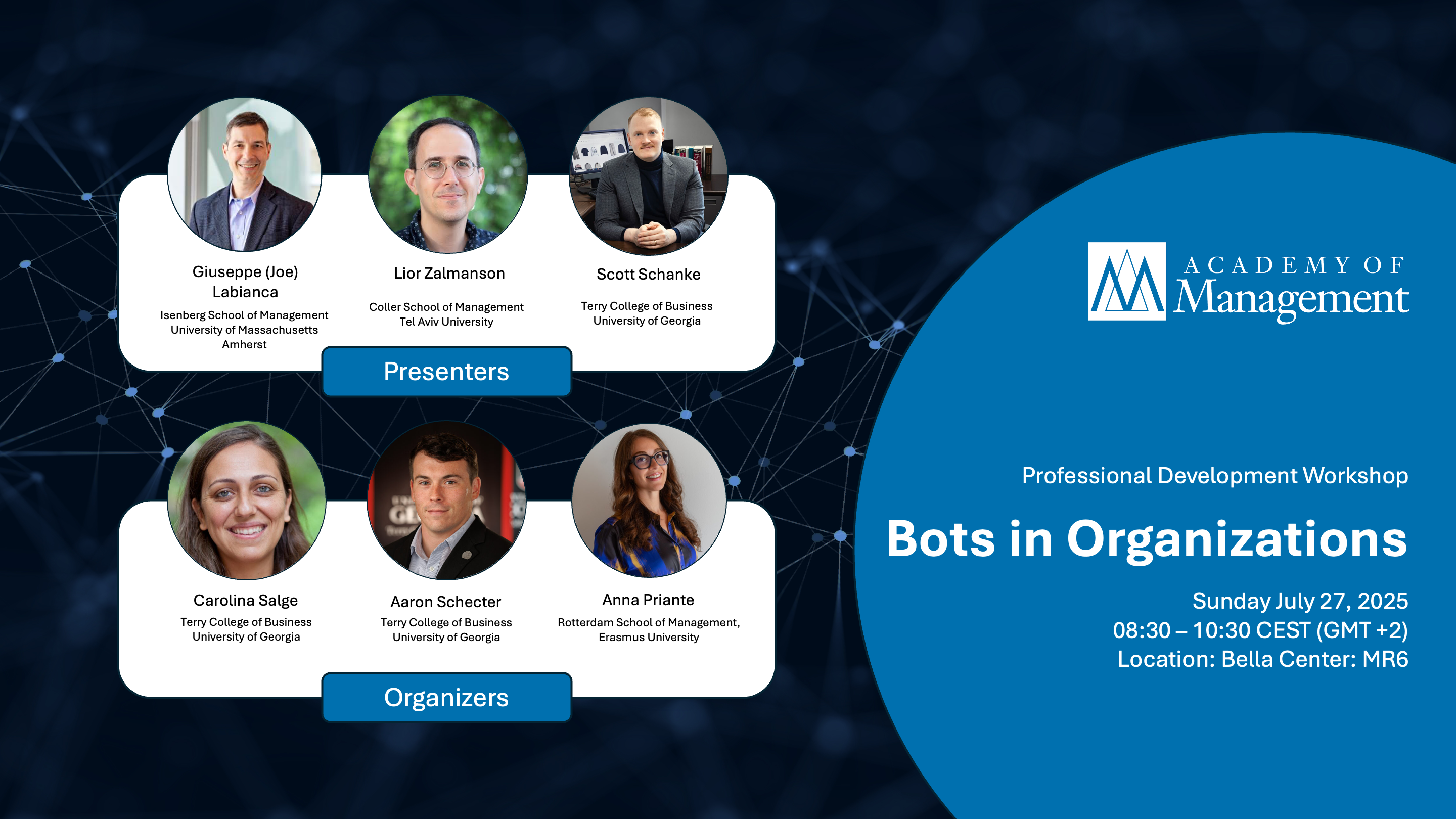
We invite you to our PDW "Bots in Organizations" on Sunday July 27, 2025, from 08:30 AM – 10:30 AM (CEST, GMT +2) at the 2025 AOM Conference in Copenhagen!
Bots, described as agentic information systems (IS) artifacts, are everywhere: on social media spreading false news rapidly and affecting political elections worldwide (Bessi and Ferrara 2016; Martini et al. 2021; Mønsted et al. 2017; Shao et al. 2018), in online communities moderating user generated content and participation (Hukal et al. 2019; Safadi et al. 2021), and more recently on business websites providing a variety of services to customers (Han et al. 2023; Schanke et al. 2021). Whether we like it or not, bots are the new normal and here to stay. As previous work has shown, they can behave ethically or unethically (Salge and Berente 2017) and methodologically speaking, bots can pose challenges to research validity due to the potential confounding effects they introduce (Salge and Karahanna 2018).
Following our last three Professional Development Workshops (PDWs) on bots at the Academy of Management Annual Meetings in Seattle, Boston and Chicago, we have acquired significant knowledge about the opportunities and challenges within bot research, particularly as it relates to bot detection on social media, a now mature line of work (see Cresci 2020). Eager to continue enriching discussions and strengthening ties within the AoM community, this year PDW aims to:
- Present theoretical frameworks that help explain the impact of bots for organizational learning and performance.
- Discuss the most effective methods for studying bots in firms (e.g., field studies, experiments, simulations, interviews, etc).
- Explore the human-bot collaboration at the workplace, including psychological effects of integrating bots into structures, workflows, and decision-making processes.
- Address ethical concerns arising from business bots (e.g., job displacement, privacy concerns) as well as biases in decision-making and how to strive for transparency and fairness in bot usage.
The PDW consists of two parts. First, leading experts will share their thoughts and experiences on the objectives outlined above. The second part will feature a panel discussion with the presenters, panelists and participants.
As always, this PDW looks to maintain and continue to develop the multidisciplinary community of scholars dedicated to bot research, an interest group we began four years ago in Seattle.
This PDW DOES NOT require special registration and is open to all Academy members interested in studying bots at multiple levels of analysis.
For additional details, please contact Carolina Salge (calsalge@uga.edu).